Quick answer
How do you write a software RFP for a business software project?
To write a software RFP, describe your business and the problem, list the users and must-have features, state your data, integration and security needs, set the budget range and timeline, and tell vendors exactly how to reply. Then share the same RFP with three to five vendors and score every reply on the same scorecard.
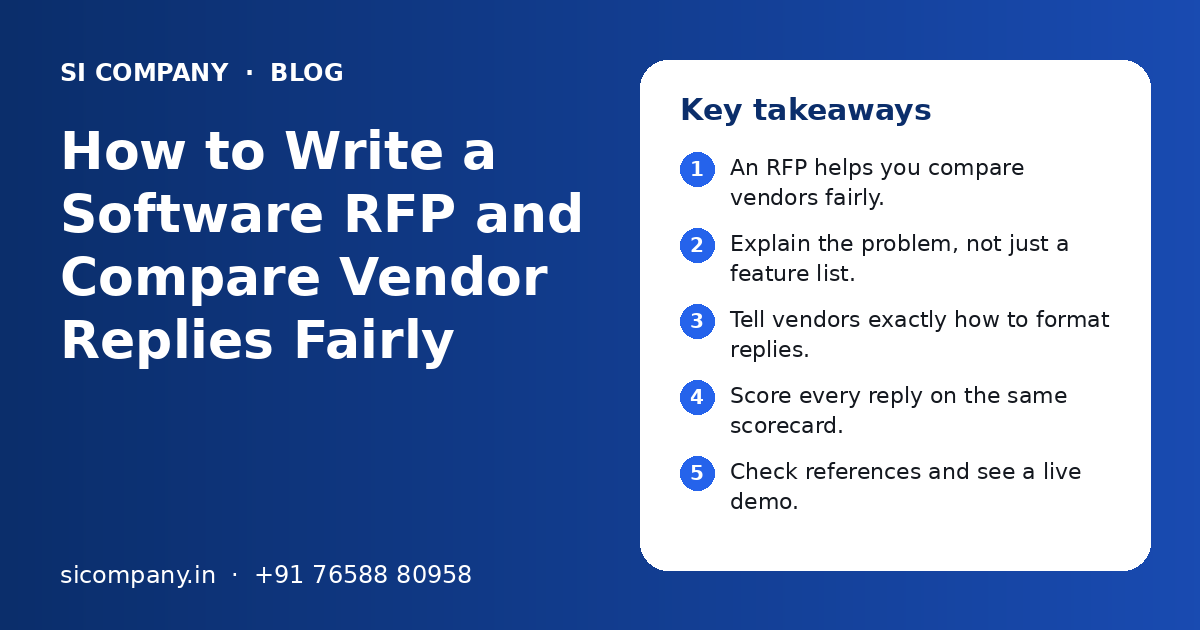
Key takeaways
- An RFP helps you compare vendors fairly.
- Explain the problem, not just a feature list.
- Tell vendors exactly how to format replies.
- Score every reply on the same scorecard.
- Check references and see a live demo.
- Agree on scope, support and code ownership.
What is a software RFP, and when do you need one?
A software RFP (request for proposal) is a written document that explains your project and asks vendors to send a proposal in a set format. You need one when you plan to compare more than one vendor for a project that is too large to decide on a single phone call.
Many small businesses skip this step. They explain the project a little differently to each vendor and get quotes that cover different things. One includes hosting and training. Another does not. You end up comparing prices for different work.
An RFP fixes this. Every vendor reads the same document and answers the same questions. Learning how to write a software RFP takes a few days of effort, but it can save months of trouble later.
RFP, RFI and RFQ: what is the difference?
| Document | What it asks for | When to use it |
|---|---|---|
| RFI (request for information) | General details about the vendor and their experience | When you are still exploring options and want a shortlist |
| RFP (request for proposal) | A full plan, approach, timeline and cost for your project | When you know the problem and want detailed proposals to compare |
| RFQ (request for quotation) | Only a price for a clearly fixed scope | When the scope is already final and price is the main question |
What should you prepare before writing the RFP?
Before you write the RFP, agree inside your company on the problem, the decision makers, a rough budget range and the date you need the software. Without this, the RFP will be unclear and vendors will fill the gaps with guesses.
- A clear statement of the business problem in two or three lines
- A list of departments and roles that will use the software
- Your current tools, such as Excel, Tally, an old system or WhatsApp groups
- A rough budget range that management has agreed to
- A target go-live date and any fixed deadlines, such as a financial year start
- A basic requirements list, even if it is not complete
The requirements list is the heart of the RFP. If you have not made one yet, our post on the software requirements checklist walks you through it. The RFP then wraps those requirements with the business context, the reply format and the selection rules.
If your team is not sure what the software should do, it can help to get an outside view first. A short technology consulting session can turn a loose idea into clear needs before you go to vendors.
What should a software RFP include?
A good software RFP includes your company background, the problem, the scope, functional and technical needs, budget and timeline, the reply format and how you will choose. Each part answers a question a vendor would otherwise have to guess.
| RFP section | What to write |
|---|---|
| Company background | What you do, team size, locations and how you work today |
| Problem and goals | The problem in plain words and what success looks like |
| Scope | What is in this project and what is not |
| Users and roles | Who uses the system and what each role does |
| Functional needs | Features, marked as must-have, should-have or nice-to-have |
| Data and integrations | Old data to move and tools to connect, such as Tally, UPI or WhatsApp |
| Technical and security needs | Hosting, devices, access control, backups and data location |
| Support and training | Training, warranty period and ongoing support you expect |
| Budget and timeline | A budget range and key dates |
| Reply format and dates | How to structure the reply, the deadline and contact person |
| Selection process | How you will score replies and the next steps |
Write user stories, not only feature names
A feature name like "inventory module" means different things to different vendors. A short user story is clearer. For example: "The store manager checks the stock of an item at each branch from a phone." Write five to fifteen of these for the main roles. Vendors then price what you actually need.
How do you write a software RFP step by step?
Write the RFP in a fixed order: set the goal, collect inputs from users, draft the sections, add the reply format, review it inside the team and then send it to a shortlist. The steps below suit most small and mid-sized Indian businesses.
- 1
Set the goal and owner
Write the business problem in two or three lines and name one person who owns the RFP.
- 2
Talk to the people who will use it
Spend time with sales, accounts, store and field staff. Note what slows them down today.
- 3
List and rank the requirements
Mark each item as must-have, should-have or nice-to-have. Keep the must-have list short.
- 4
Describe data, integrations and security
Name the tools to connect, the old data to move and who should see what.
- 5
Share a budget range and timeline
Give a range and the key dates. Vendors can then propose a phase-wise plan that fits.
- 6
Fix the reply format
Ask every vendor to answer in the same order, with a separate cost sheet.
- 7
Review internally
Ask the decision makers and one or two users to read the draft and point out gaps.
- 8
Send to a shortlist
Share the RFP with three to five vendors, along with a deadline and a date for questions.
Give vendors enough time to reply. Allow a short window for vendor questions, and share every answer with all vendors so the process stays fair.
Need help with your project?
Talk to the SI Company team. Free first call, simple advice, clear quote.
How do you compare vendor replies fairly?
Compare vendor replies with a weighted scorecard that you prepare before the replies arrive. Each member of the selection team scores each vendor on the same points, and you add the scores to get a shortlist for demos.
| What you score | Sample weight | What to look for |
|---|---|---|
| Understanding of the problem | 20 | Did they restate your problem clearly and ask good questions? |
| Fit with must-have needs | 25 | How many must-haves are available or clearly planned? |
| Relevant experience | 15 | Have they built similar systems for similar businesses? |
| Project plan and team | 10 | Are the phases, dates and team roles realistic? |
| Total cost over three years | 15 | Build, licences, hosting and support added together |
| Support and ownership terms | 10 | Support hours, response times, code and data ownership |
| Communication | 5 | Were they clear, on time and easy to work with during the RFP? |
Read the assumptions, then look at total cost
Ask every vendor to reply in the same order as your RFP and to fill in one cost sheet, split into build, licences, hosting, integrations, migration, training and support, shown before and after GST. Then read each assumptions list. It shows what the vendor has not included.
A low build price with high yearly licence or support fees can cost more over time. Add up the build cost, licences, hosting and support for at least three years for each vendor. Our post on subscription vs one-time licence explains this trade-off in more detail.
Signs of a strong proposal
- Restates your problem in their own words
- Asks smart questions about your process
- Lists assumptions and exclusions clearly
- Suggests a phase-wise plan with a small first release
- Names the team and the main contact
Warning signs
- Says yes to every requirement without any detail
- Gives one lump-sum price with no breakup
- Copies a generic brochure instead of answering
- Promises very short timelines for large scope
- Avoids questions on code and data ownership
What should you check before choosing the final vendor?
Before you choose, see a live demo built around your use cases, speak to past clients, and agree on the scope, support and ownership terms in writing. A good score on paper must be confirmed by what you see and hear.
- A demo of real screens using your own sample process, not a standard sales demo
- A call with at least one past client of a similar size
- Clear written scope with a list of what is not included
- Milestone-based payment terms tied to working deliveries
- Written terms on who owns the source code and the data
- Support hours, response times and the cost of support after the warranty
- A simple change request process for new needs during the project
For larger or multi-department systems, you may also ask the top two vendors for a short paid discovery phase. This produces a detailed scope and design before the full build starts. Our enterprise solutions team often works this way on bigger projects.
Ask how the vendor will handle support after go-live. A software maintenance and support plan should cover bug fixes, small changes, backups and updates. Also ask for proper documentation; our software documentation checklist lists what to expect.
What mistakes should you avoid when writing a software RFP?
The most common mistakes are copying a generic template, listing too many must-haves, hiding the budget and judging vendors only on price. Each of these leads to proposals that are hard to compare or a project that goes off track.
- Using a downloaded RFP template without changing it for your business
- Marking every feature as must-have, which pushes up cost and time
- Not sharing any budget range, so vendors guess and quotes swing widely
- Leaving out data migration and integrations, then paying extra later
- Picking the lowest quote without checking what it leaves out
- Not involving the staff who will use the software every day
- Signing without clear terms on support, code and data
Another mistake is writing the RFP around a solution instead of a problem. If you write "we need an ERP", you will get ERP quotes. If you write "we lose track of orders between sales and the warehouse", vendors may suggest a smaller, faster fix. Our guide on ERP for small business can help you judge whether a full ERP is the right size for you.
How can SI Company help with your software RFP?
We can help you write a clear software RFP and we can also reply to one as a vendor. If you want a neutral view, we can help you shape the requirements first and then you decide who to send the RFP to.
Our custom software solutions cover CRM, ERP, portals, dashboards and automation. When we reply to an RFP, we share a written scope, a phase-wise plan and a cost breakup in your format.
SI Company is powered by Shivah Web Tech, with 11+ years of experience, a 25+ member in-house team and 500+ projects. We work Monday to Friday, 9:30 to 6:30 IST, with 24x7 support for urgent issues. Cost depends on your scope, so you get a clear quote after a free call. Contact us to share your RFP or ask for help writing one.
Frequently Asked Questions
What is the difference between an RFP and a quotation?
A quotation gives only a price for work that is already clearly defined. An RFP asks vendors for a full proposal: their understanding of the problem, their solution, plan, team, timeline, support terms and a cost breakup. Use an RFP when you want to compare approaches as well as prices, which is the case for most business software projects.
Should I share my budget in the RFP?
Yes, sharing a budget range usually helps. Without it, vendors guess, and you get quotes that are very far apart. A range lets vendors propose what fits, such as a smaller first phase with more features later. You do not need to share an exact figure. A range and your priorities are enough to get useful proposals.
How many vendors should receive my software RFP?
Three to five vendors is a practical number for most businesses. Fewer than three gives you little to compare. More than five means a lot of reading and meetings, and good vendors may not reply if they feel the process is too crowded. Use a short RFI or phone calls first if you need to build the shortlist.
How much time should vendors get to reply to an RFP?
Give enough time for a careful reply, usually a couple of weeks for a normal business project. Larger or complex projects may need more. Include a date for vendor questions and share every answer with all vendors. A very short deadline often produces copy-paste replies that do not answer your actual needs.
Can I use a free software RFP template?
You can use a template as a starting point for the section headings. But do not send it unchanged. A template does not know your business, your users or your problems. Replace every generic line with your own details, remove sections that do not apply and add the specific user stories and integrations your project needs.
Who should own the source code after the project?
For custom software, many businesses ask for full ownership of the source code and data once payments are complete. For ready-made products, you usually get a licence to use the software, not the code, but you should still own your data and be able to export it. Write these terms clearly in the contract before you sign.